
As I write this, the US administration has signalled its assessment that the war it started with Iran is nearly over. Let’s hope that turns out to be accurate. But even a brief war in the Persian Gulf has exposed a huge liability in the world’s economic order, and Ireland’s place within it: energy prices have surged, with an Iranian official saying oil may go up to $200 per barrel, a nearly unprecedented level.
This vulnerability in the international energy market points to a more fundamental weakness in the global economic model which was developed in the post-WW2 period and defined global politics since: an interconnected liberal trade apparatus where supply chains cross borders regularly, international shipping and trade form the bedrock for multiple industries, and a ubiquitous and relatively cheap energy supply provides a core foundation not just for economic activity, but for social and political progress. In Europe, we witnessed the shock of major energy supply changes during the Russian invasion of Ukraine and the subsequent change in trade of energy supply between the Russian Federation and many EU states; but changes to energy and shipping supplies in the Red Sea, Persian Gulf, and the surrounding area have far more meaningful global effects.
When I was in business school over a decade ago, I learned about global energy economics, a field in which experts forecasted the world’s energy position into the middle of this century. One lecture by an economist in particular really stayed with me. In summary, the lecture basically said the following:
- There are 5 major mainly self-contained energy markets
- 1) the Americas, where energy supply and demand fundamentally match between all the supply and demand across the North and South Americas, with the US particularly eager to secure energy independence from its own production capacity – not just in oil, but also in the large investment in renewables (Texas’s huge development of solar and wind capacity is a good example)
- 2) The European continent, widely defined including Russia, where gas reserves from the East form the bedrock for energy supply (and this was before Germany decided to decommission its nuclear power stock). Notably, France was most insulated from major energy shocks, given that about 80% of its power is developed from nuclear.
- 3) China’s energy demand is significant and growing – outstripping its indigenous oil and gas supply, but that gap is narrowed with investment primarily in nuclear and renewables
- 4) India’s energy demand is similarly significant and growing, with less progress than China on developing indigenous supply
- 5) The Gulf states and the surrounding area produce a huge proportion of the world’s moveable energy supply in oil and gas and associated products, far outstripping its own needs or even that of Africa, which are relatively small in comparison to the larger economic actors in other parts of the globe.
The major point that the economist presented was that with growing populations in China, India, and Africa, where there are indigenous energy deficits relative to economic demand, there would be significant competition between them to access the surplus in the Gulf region in the middle of this century.
Of course, what that economist did not predict was the change in posture of Russian energy supply, pivoting from supplying Europe to somewhere else – India being the main beneficiary since the Ukraine war. This, combined with China’s unprecedented progress in renewables and nuclear, has established a different kind of dynamic from the one that was expected to exist.
So who’s the odd one out? Europe.
Here in Ireland, there’s been a good deal of discussion in the Dáil about energy security and what that should mean. The government’s position is that energy security is critical for economic success, and their solution has largely relied on the importation of energy from other countries, notably the development of an LNG terminal in Kerry, initially earmarked for US imports of deeply environmentally-damaging shale gas. Meanwhile, the government has presided over zero progress on offshore windfarms.
Without debating the merits of the government’s arguments on what it should do and when, there is a very real energy security problem in Ireland and in Europe. We have not sufficiently invested in renewables – even though we have a huge capacity in wind in particular – and at the same time, we’ve accelerated energy demand with things like data centres. Ireland is now the data centre capital of the world.
To put that in context, data centre usage in the United States is becoming a hot topic on energy supply, prices, and security. No similar analysis I can find exists for the Irish or European context.
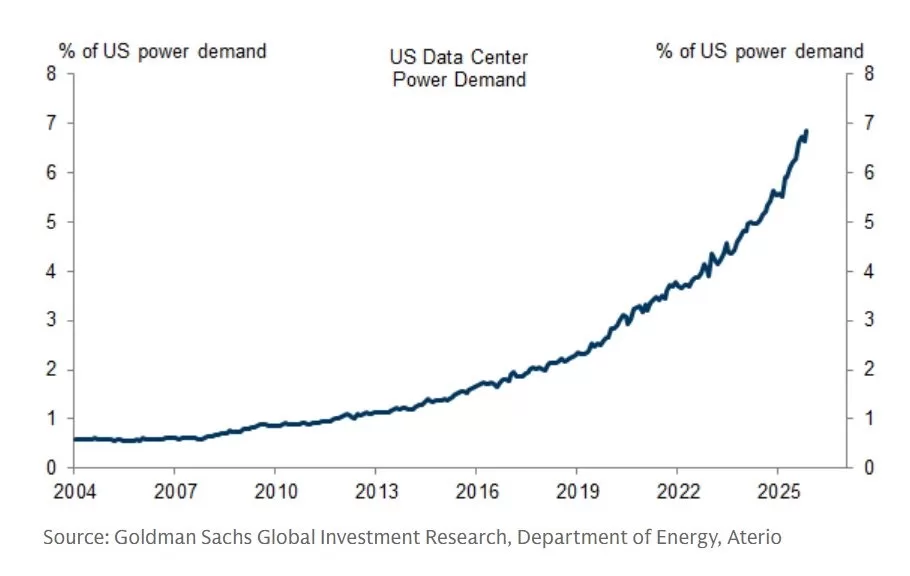
Data centre power demand in the US is concerning at 7%. In Ireland this figure is at least 22%
In summary, we are a small country that imports most of our energy, leaving us exposed to international energy price shocks. We are part of a continental infrastructure in Europe that has a similar energy security and energy deficit problem, far beyond other parts of the world. And a huge proportion of our economy is reliant on availability and relatively cheap supply of energy.
The effect of a major change in the international energy economy could be disastrous for a country like Ireland. Not only are our people reliant on foreign energy supply, but the biggest drivers of economic performance – multinationals in AI, pharmaceuticals, medical devices, and electronic devices – need reliable and relatively affordable energy supply to make the microeconomics of their companies and industries on this island work. We’re already seeing the imbalanced advantages these companies have in preferential energy supply prices vs. residential consumers. If energy supply constricts, who’s most likely to pay for the drastic increase in costs?
There are short-term solutions to any price shock in any market a government can utilise – subsidisation being the most common one – but there are very real questions about how this government and the State itself gets renewables up and running in quick time. It’s very possible our entire economic future depends on it.