The recent flooding around the country resulted in renewed concern about the levels of flood defences and flood planning for the communities most at risk. As we grapple with the consequences of climate change, we need to have a strong sense of foresight and realism in how we deal with the reality facing us. That means not burying our heads in the sand and dealing with things as pragmatically as possible as we continue to advocate for substantive climate action and decarbonisation.
The issue of flood protection in Dublin Bay South comes down to three things: climate action, physical flood defence infrastructure, and flood insurance. They are interconnected and interdependent, particularly flood defence and flood insurance, as the functioning of the insurance markets rely on tangible assurances that can be provided by a solid understanding of and managing of the risk profile of specific areas.
This is a big part of the reason why so many people have had issues getting flood insurance coverage in Dublin Bay South – persistent delays to the delivery of flood defence infrastructure that has been recommended now for decades. Promisingly, there have been very welcome recent announcements that the flood defence scheme at Sandymount will have its planning application submitted next year. Flood defences and mitigation schemes, especially nature-based ones, are critical to reduce flooding risk. However, insurers in other coastal areas such as Clontarf and Wicklow have still resisted insuring homes even after flood defenses were implemented, which raises questions about the quality of the interventions that are being implemented.
The other key factor here is a regulatory one, and in my opinion a government policy one. It’s clear that the private insurance market is not going to provide the necessary levels of coverage under the current operating conditions. The government has consistently said that they can’t intervene in the market, and given various reasons for this, including EU regulation.
But since getting elected to the Dáil in 2024, I’ve spent a lot of time working on this issue and researching international best practice, including among our European neighbours. It’s clear to me that a functional provision of flood defence for at-risk coastal communities is not only possible, but it is achievable with just a little bit of ambition. Not only that, but the risks of not doing this are huge, and will result in a much costlier remediation process for any future flooding events. This is why I’ve persisted with the issue in the Dáil and in my engagements with government ministers. Here’s a timeline of my work on this issue, which also breaks down the development of my understanding of the changes needed to insurance provision which can lead to a truly functional market and sufficient flood coverage for everyone in Dublin Bay South:
- Having spoken to residents and businesses during the election campaigns in 2024, I had a sense of the difficulties many faced in getting flood insurance coverage, particularly in the areas of Ringsend, Sandymount, Merrion and Irishtown. While attending residents association meetings in early 2025, I began to get a real sense of the scale of the problem and how many people were tearing their hair out trying to get someone to listen.
- In June of 2025, I brought the issue to the floor of the Dáil, asking the Taoiseach to set out the government’s position on reform of the insurance market and what they would do to engage with providers so that levels of coverage could be enhanced. The Taoiseach’s response focused on the responsibility of insurance companies to engage once flood defences have been erected, which seemed to me to skirt around the issue at hand, but he did helpfully direct Minister of State at the Department of Finance to engage with me on this issue, so I was happy to get the ball rolling in terms of a more substantive engagement on this at government level.
- Having engaged with Minister Troy on the issue on numerous occasions since then, I was able to put forward some ideas about the kinds of necessary and achievable changes to the way in which extreme weather events, and particularly coastal flooding, could be addressed through schemes structured around state backing and private sector engagement.
- When I raised it again at Oral Questions with the Tánaiste and Minister for Finance, Simon Harris, I was surprised by the number of backbenchers in Fianna Fáil and Fine Gael that supported my requests for interventions.
The two most viable options as I see it are a state reinsurance scheme, or an extra-policy state compensation scheme, which is what I told Minister Troy. Some of the main contentions I’ve heard on these proposals have been to do with the EU solvency II framework. I won’t go into too much detail here, but what the framework does essentially, is set out strengthened requirements around capital, governance and risk management in all EU authorised (re)insurance undertakings. It came into effect in 2016 but has its routes in EU legislation dating back to the 1970s.
However, international best practice, and the different types of scheme available in our EU neighbours shows us how such schemes might be possible within a regulatory environment that includes the Solvency II framework. Here’s a simplified breakdown of how these schemes might work and interact with the provision of flood insurance in consumer-held primary policies:
Flood Insurance:
Flood insurance is a type of insurance cover that compensates policy holders in the case of minor or major damage to their property and its contents in the case of a flooding event. It has been reported to me by many constituents that availability of flood insurance cover has been low along South Dublin’s coast, and current policies are expensive and restrictive.
State Reinsurance Schemes:
One possible solution for providing flood insurance cover where the industry is unwilling to extend it is to introduce a system whereby insurance companies would cover the risk associated with flooding, but can then indemnify themselves against the risk of that event occurring, by taking out their own insurance policy (called ‘reinsurance’) with the state, which will shoulder some of the financial cost of paying out to homeowners in the event of a flood. These schemes are in operation in the UK and France.
Extra-policy State Compensation Schemes:
European Union Solvency II regulations might prevent the state from getting involved as a primary provider of insurance policies directly to individuals, but as demonstrated by schemes such as the CCS scheme in Spain, there is nothing to prevent the state setting up compensation mechanisms whereby risks which are considered outside of the scope of those covered by private insurance companies. Think of it like creating a “public layer” of insurance that kicks in for claims not included in your private policy, such as flooding. Such schemes are also operational in Germany.
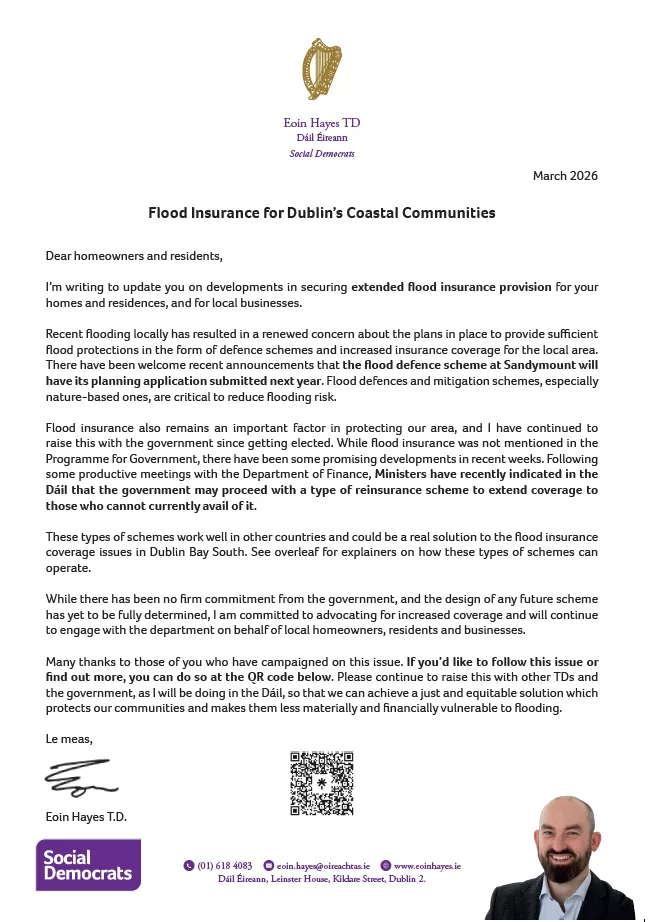
The initial government opposition seems to have softened somewhat recently. It is with some surprise that I have noted a recent willingness of the government to talk about the need for state involvement in flood insurance solutions – Minister Troy indicated that a state backed scheme may be needed. Well, he indicated that it may be needed for businesses at least. I’ve since called on him to include homes in any such schemes, given the huge numbers of homeowners and residents affected by this issue. I’ve also sent out a letter to constituents in the coastal communities of my constituency updating them on the situation.
It’s an encouraging development, but by no means a guarantee, which is why I’m continuing to press the government on this issue, and will continue to engage Minister Troy and raise it at every available opportunity until Dublin Bay South has the flood insurance coverage it needs and deserves.